AI agent traffic in numbers (2025–2026)
What Cloudflare, Adobe, Pew, Imperva, HUMAN and Akamai have measured about AI crawlers and agents, what the numbers can and can't tell you, and what the shift means for your website.
Picture a visit to your pricing page at 3 a.m. Nobody scrolls. Nobody hovers over a button. The page is fetched, read and gone in under a second. A few minutes later, someone in another city asks an AI assistant which plan to pick, and the answer quotes your prices. Or it doesn't, because the prices loaded after the visitor left.
Visits like that are no longer the odd one out. In May 2026, according to Cloudflare, automated traffic overtook human traffic on the web. Here's what the major measurers have published from 2025 to 2026, what it means, and where the numbers need a pinch of salt.
The headline numbers
These are the figures that matter most, with the period each one covers. All of them are the vendors' own data.
| What was measured | Number | Period | Source |
|---|---|---|---|
| Automated traffic overtook human traffic | It happened in May 2026; Cloudflare had forecast the second half of 2027 | May 2026 | Cloudflare |
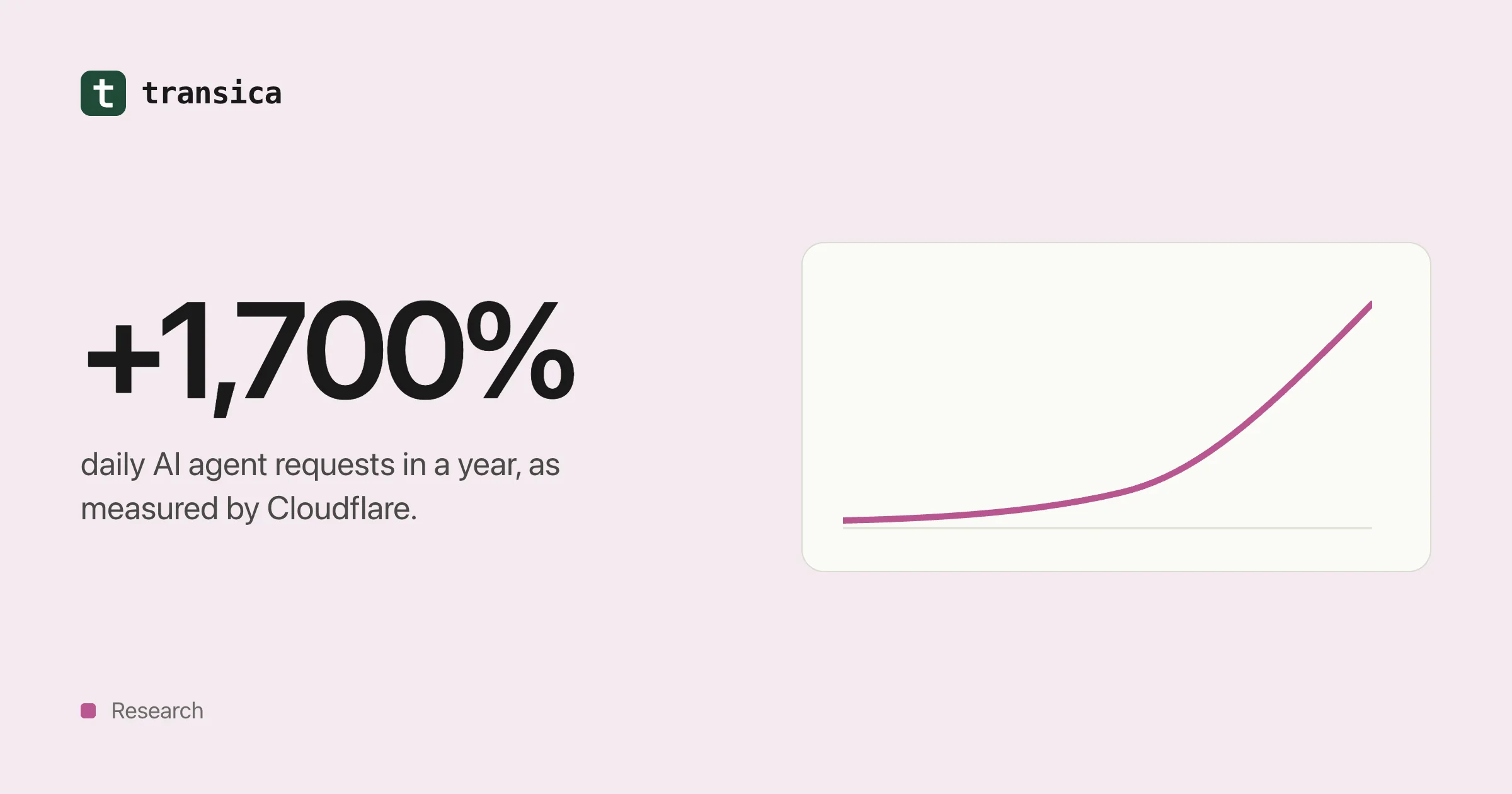
| Daily AI-agent requests | Up more than 1,700% in a year | Year to September 2026 | Cloudflare |
| AI bots' share of HTML requests | 4.2%, against 4.5% for Googlebot | 2025 | Cloudflare Radar |
| Crawling triggered by people's requests | Grew "over 15x" (21x in the body text) | 2025 | Cloudflare Radar |
| Automated share of all web traffic | 51% in 2024, 53% in 2025 | 2024 to 2025 | Reported by Imperva (2025, 2026) |
| Bad bots' share of web traffic | 37% | 2024 | Reported by Imperva |
| Automated share of commerce traffic | 47.9% | End of 2025 | Akamai, reported by IT Brief |
| Agentic traffic growth | Nearly 80x, reaching 1.7% of AI-driven traffic in December | 2025 | HUMAN Security, reported by The Batch |
| Agent visits to product or search pages | 77% of agent interactions | 2025 | HUMAN Security, reported by The Batch |
Read down the table and a picture forms. Machines now make more requests than people. Most of that is still crawlers. But the slice that acts for a specific person, right now, is the slice growing fastest. And when those agents arrive, they go where buyers go: product pages and search.
HUMAN's numbers make the same point from another angle. In 2025, AI-driven traffic nearly tripled, automated traffic grew more than 23%, and human traffic grew about 3%, as reported by The Batch. Imperva's 2026 report, as published on its blog, calls AI agents "a new category of internet participant".
Crawlers take, agents act
There are two very different kinds of AI visitor, and it helps to keep them apart.
Crawlers read your pages in bulk, mostly to train AI models or build a search index. They rarely send anyone back.
Agents visit because a person asked for something: "compare these two plans", "book a table for Friday", "is this in stock in a size 10?" They act on that person's behalf.
Cloudflare measures the first kind with a crawl-to-refer ratio: how many pages a company's crawlers fetch for every visit its products send back to the site. Lower is better for you.
| Company | January 2025 | July 2025 | Change |
|---|---|---|---|
| Anthropic | 286,930 : 1 | 38,065 : 1 | Better, still very high |
| OpenAI | 1,217 : 1 | 1,091 : 1 | Slightly better |
| Perplexity | 54.6 : 1 | 194.8 : 1 | Worse |
| 3.8 : 1 | 5.4 : 1 | Worse, still lowest of these four |
Source: Cloudflare, 29 August 2025. Cloudflare's 2025 Year in Review says Anthropic's ratio peaked at about 500,000 to 1.
There's an important caveat on that Anthropic number. Cloudflare itself notes that Claude's app sends no Referer header, so visits it sends may not be counted as referrals, and the ratio may be overstated. For the week of 19 to 26 June 2025, Cloudflare put Anthropic at about 70,900 to 1 with that warning attached (Cloudflare, 1 July 2025). The same gap can hide AI visits in your own analytics, which we'll come back to.
Why are the crawlers out there? Over the 12 months Cloudflare looked at to July 2025, about 80% of AI crawling was for training, 18% for search and 2% for user actions (Cloudflare). In a later post, Cloudflare reports that training's share of crawler requests rose from 22% in spring 2025 to 52% in June 2026 (Cloudflare, 30 September 2026). The two posts measure different things, so don't add them together. Both say training is a big and growing reason crawlers come.
Site owners have noticed. In a September 2026 post, Cloudflare reports that 17% of sites on its network block training crawlers, and under 1% block search crawlers (Cloudflare). That split makes sense. Training crawlers take. Search crawlers and agents can bring people.
The 2% "user actions" slice is small, but it's the one that grew "over 15x" in 2025 (Cloudflare Radar), and it's the one that turns into customers.
People click less, but the clicks are worth more
AI answers change how people move from a question to your site. Pew Research looked at the browsing of 900 US adults in March 2025 (Pew):
- 18% of their Google searches showed an AI summary.
- When a summary appeared, they clicked a result on 8% of visits. Without one, they clicked on 15%.
- They clicked a link cited inside the summary about 1% of the time.
Google, for its part, says its AI features send "billions of clicks" to websites every week, without giving an exact figure (Google, 22 July 2026).
So fewer people click. But Adobe's retail data says the ones who arrive from AI tools are unusually ready to buy. These figures are for traffic from AI tools to US retail sites:
| Period | Growth in AI-referred traffic | Other details | Source |
|---|---|---|---|
| 2025 holiday season | Up 693.4% year on year | Cyber Monday up 670% | Adobe, 7 January 2026 |
| Q1 2026 | Up 393% | In March 2026, AI traffic converted 42% better than other traffic, with 37% higher revenue per visit | Adobe, reported by TechCrunch |
| 2026 holiday forecast | Up 130% | Thanksgiving up 159%, Black Friday up 95%, Cyber Monday up 88%; total online sales forecast at $275.1B | Adobe, 28 September 2026 |
Some coverage gives Thanksgiving as up 141%. Adobe's own release says 159%, so we use that.
These are growth rates. A big percentage on a small base can still be a small number of visits, so read them as direction rather than size. The direction is clear, though: more shoppers are starting in an AI assistant, and the ones who reach a store from there convert better.
The audience behind the agents
Agents act for people, and there are a lot of people.
- ChatGPT has 1.2 billion weekly users, a figure Sam Altman gave at DevDay on 29 September 2026, as reported by Engadget. In February 2026, the figure was 900 million, as reported by IT Daily.
- Gemini has 950 million monthly users, and Google's AI Mode passed 1 billion monthly users, according to Alphabet's Q2 2026 update.
Not every one of those people sends an agent to a website. But it only takes a small share of them asking an assistant to check, compare or book something to produce a lot of visits. Those are the people the agents in Cloudflare's 1,700% figure are working for.
From reading your site to using it
A crawler only needs to read. An agent has to do something: find the right plan, fill a form, add to cart. That's harder, and the research shows how much harder.
| Study | Agent using the website | Agent using the API or tools | Source |
|---|---|---|---|
| Beyond Browsing, WebArena tasks, GPT-4o | 14.8% success | 29.2% with API only, 38.9% with both | Song et al. |
| Same study, GitLab tasks | 12.8% | 43.9% | Song et al. |
| Same study, map tasks | 20.2% | 45.4% | Song et al. |
| Terminal Agents Suffice, 729 enterprise tasks, Claude Sonnet 4.6 | 72.2% at $3.29 a task | 72.7% at $0.56 through a terminal and API; 32.9% through generic MCP tools | Terminal Agents Suffice |
Browser agents also move slowly. The OSWorld-Human study found agents take "tens of minutes" on tasks that take people a few minutes, and even the best agents use 2.7 to 4.3 times more steps than they need (OSWorld-Human). And vendor scores don't always hold up. An independent re-check put OpenAI's Operator at 68.6% on WebVoyager, against the 87% OpenAI reported (Emergence, March 2026).
Look at the last row of that table, though, because it's the honest caveat. In that study, the web agent nearly matched the terminal and API agent, at almost six times the cost per task. And agents using generic MCP tools did worst of all: 32.9%, less than half the web agent's score. A badly designed app is not a shortcut. Another study found that 97.1% of 856 MCP tool descriptions had at least one problem, and 56% didn't clearly say what the tool was for (MCP Tool Descriptions Are Smelly!).
So the lesson isn't "any app beats any website". It's this: when an agent gets a direct tool built for the job, with a clear name and clear inputs, it skips the guessing that sinks browser agents. When the tools are vague or just mirror every endpoint, it guesses anyway. The only way to know which you have is to test it.
Reading these numbers carefully
Every figure in this post comes from someone with a particular view of the web. A few things to keep in mind:
- It's vendor data. Cloudflare's figures are its own and not independently audited. Imperva, HUMAN, Akamai and Adobe each measure the traffic they can see. None of them sees the whole web.
- Referer gaps hide AI visits. When an AI app sends no Referer header, as Cloudflare notes for Claude's app, the visit can look like direct traffic in your analytics. Your own reports may undercount AI referrals.
- Definitions vary. Some coverage describes Akamai's 47.9% as "AI bots", but it measures all automated traffic to commerce sites. Cloudflare's own Year in Review gives user-action crawling growth as "over 15x" in one place and 21x in another.
- Scope varies. Adobe's numbers are US retail sites. Pew's are 900 US adults in March 2025. Your sector may look different.
None of this undoes the trend. Every source points the same way. Just be wary of anyone who quotes one of these numbers as if it describes your site.
What this means for you
- Check what agents see. If your prices, stock or booking options load after the page does, an agent may read an empty shell. A quick scan shows you.
- Decide on crawlers on purpose. Blocking training crawlers is common (17% of sites). Blocking search crawlers is rare (under 1%). Make that call deliberately, not by accident.
- Expect fewer, better visits. Pew's data says people click less when AI answers. Adobe's says the ones who arrive convert better. Make sure the page they land on works.
- Give agents a direct route. For the jobs people ask about most, a well-designed app is the more reliable path than hoping an agent can work your website.
- Test, don't assume. The research shows tool quality decides the result. Run the same task on your site and in your app, and count how many runs succeed.
Where to go from here
To put your product where these agents work, start with where to list your MCP server, then turning your API into an MCP server and hosting it. Transica turns your API into an app for ChatGPT, Claude and other assistants, prepares it for each directory's review, hosts it on your own domain behind your existing sign-in, and monitors it. Our agent tests send an AI agent through the same task on your website and in your app, and report exact pass counts for each. Want to see how agents see your site today? Scan a page for free, with no account.
See how AI agents use your site today. Free page scan, no account needed.
Scan a pageKeep reading
Who's already inside ChatGPT, Claude and Copilot
A dated timeline of the brands that built apps for AI assistants from 2024 to 2026, what those apps let people do, how the checkout experiment went, and what a mid-size business can take from it.
How to get your product listed in ChatGPT and Claude (2026)
ChatGPT has 1.2 billion weekly users and Claude's directory lists 973 connectors. Here's what each directory asks for, side by side, what the big brands did first, and the mistakes that get apps bounced.