How to get your product listed in ChatGPT and Claude (2026)
ChatGPT has 1.2 billion weekly users and Claude's directory lists 973 connectors. Here's what each directory asks for, side by side, what the big brands did first, and the mistakes that get apps bounced.
You want people to type "book me a table for Friday" or "find last month's invoice" into an AI assistant and have your product do it. That means getting listed. Both ChatGPT and Claude run a directory, and both review what you submit.
This post covers why it's worth the effort, what each directory checks (side by side), what the first big brands built, and the mistakes that send submissions back. We've read both directories' public docs as of 17 October 2026. They change often, so follow the links before you submit.
Why bother: the audience
The numbers are hard to ignore:
| Assistant | Reach | Source |
|---|---|---|
| ChatGPT | 1.2 billion weekly users (announced at DevDay, September 2026) | Engadget |
| Gemini app | 950 million monthly users (Q2 2026) | Alphabet |
| Claude | No official user count; the directory shows 973 connectors | Claude |
And people arriving from AI are worth having. Adobe found that in March 2026, AI-referred visitors to US retail sites converted 42% better than other traffic, with 37% more revenue per visit (TechCrunch).
A listing doesn't guarantee any of that traffic. But without one, your product can't be used inside the conversation at all.
What you're actually submitting
Both directories are built on MCP, the Model Context Protocol. Your app is a small server that sits in front of your product and lists a handful of tools ("search products", "create a booking"). When someone asks the assistant for something, it calls a tool and your server does the work.
The directories review that server and its listing, not your website. OpenAI's docs now call submissions plugins: a package that can hold an MCP server, skills, or both. Claude calls them connectors.
Who went first
The first wave was big consumer brands and the tools businesses already live in.
| When | Where | Companies |
|---|---|---|
| May 2025 | Claude integrations | Atlassian (Jira, Confluence), Zapier, Cloudflare, Intercom, Asana, Square, Sentry, PayPal, Linear, Plaid (Anthropic) |
| July 2025 | Claude directory | Notion, Canva, Stripe, Figma and others (Anthropic) |
| October 2025 | ChatGPT apps pilot | Booking.com, Canva, Coursera, Figma, Expedia, Spotify, Zillow (OpenAI) |
| December 2025 | ChatGPT submissions open | Instacart launched checkout inside ChatGPT (8 Dec); submissions and the in-chat directory opened 17 Dec (VentureBeat, Instacart) |
| January 2026 | Claude interactive connectors | Amplitude, Asana, Box, Canva, Clay, Figma, Hex, monday.com, Slack (Anthropic) |
| July 2026 | ChatGPT | App directory becomes the plugin directory (OpenAI Help Center) |
Look at what they exposed. Spotify recommends music and podcasts by mood (Spotify). Zillow shows listings on a map. Stripe gives Claude access to customer and payment data. Notion and Asana read and update work. None of them put their whole product in the chat. Each picked a few jobs people already ask for.
We look at the big brands in more detail in who's already inside ChatGPT, Claude and Copilot.
What each directory checks, side by side
| ChatGPT | Claude | |
|---|---|---|
| Where you submit | Plugins page | claude.ai/directory/manage |
| Who can submit | Verified individual or organization; owners or members with Apps Management Write | Any paid Claude plan |
| Server | Public HTTPS, one MCP server per plugin | Remote server over HTTPS |
| Prove your domain | Plain-text token at /.well-known/openai-apps-challenge | No verification step; your server's domain should match your service |
| Sign-in | None, OAuth, or a mix; no API keys for public submissions | OAuth 2.0 for anything personal, or none for public data |
| Tool annotations | readOnlyHint, destructiveHint and openWorldHint, each set explicitly | A title plus readOnlyHint or destructiveHint |
| Reviewer access | Demo account with sample data | Fully populated test account |
| Test material | 5 positive and 3 negative test cases, a video walkthrough, release notes | Confirm you've run every tool |
| Review | Automated checks, then people test your cases | Automated scan; listed as Community by default, some escalated to Verified |
| After launch | Server rescanned daily; eligible tool changes go live automatically | Deploy tool changes to your server; listing edits are reviewed |
Sources: OpenAI's submission docs and guidelines; Anthropic's submission guide and review checklist.
ChatGPT in more detail
OpenAI's reviewers look for:
- A clear purpose that ChatGPT can't already cover on its own, with no impersonation or implied OpenAI endorsement.
- Quality. Predictable results, sensible error handling, and no trial or demo builds.
- Honest tools. Unique, action-oriented names and accurate descriptions, one operation per tool.
- Minimal data. Only the inputs you need, responses limited to what's relevant, never the full chat history.
- Privacy. A published privacy policy, and no collecting payment card data, health records, government IDs or passwords.
- Works everywhere. Reliable on desktop and mobile.
- A real contact. Accurate support details for your verified organization.
Claude in more detail
Anthropic organises its checklist around the most common rejections:
- No catch-all tools. A tool that both reads and writes is rejected. Split reads from writes, ideally writes into create, update and delete.
- Narrow, accurate descriptions. Say what the tool does and when to use it.
- No instructions aimed at Claude. Descriptions that tell Claude how to behave count as prompt injection.
- Useful errors. A bare "Internal Server Error" fails.
- Reasonable responses. Return what the task needs, not a database dump.
- Your own API. Call your first-party API, or one you're allowed to proxy.
- Names of 64 characters or fewer.
The listing itself has hard limits: a name of up to 100 characters, a one-liner of up to 200 and a description of up to 2,000, in 1 to 5 categories. Your listing's URL slug is permanent once published.
The mistakes that get apps bounced
Put the two checklists together and the same problems keep coming up. None of them is hard. All of them are easy to miss the first time:
- Missing or wrong annotations. Every tool needs them, and ChatGPT wants all three hints set explicitly, even when the answer is false.
- Vague tool names and descriptions. "process", "handle_request", "Makes a request to the API". Research on 856 tools found 97.1% of descriptions had at least one problem (study).
- An empty test account. Reviewers need realistic data to try your tools. A fresh account with nothing in it fails the test.
- Sign-in that only works for you. OAuth has to work for a stranger, from ChatGPT's or Claude's side, on the first try.
- One tool that does everything. Claude rejects it outright, and ChatGPT asks for one operation per tool.
- Errors that say nothing. "Something went wrong" tells the agent nothing it can fix.
- No published privacy policy.
- A server that's slow to wake up. In our experience, reviewers and users see timeouts.
After you're listed
Approval is the start. ChatGPT rescans hosted servers daily and publishes eligible tool changes after automated checks. So a rename on your server can change what people see in ChatGPT the next day. On Claude, tool changes go live when you deploy them, but changing the tool names on your listing takes a reviewed listing edit. Our guide to keeping your listings healthy covers what to watch.
What this means for you
- The audience is there. Hundreds of millions of people use these assistants every week.
- Big brands started with a few focused jobs. You can do the same with a much smaller team.
- Both directories check similar things: honest tools, working sign-in, a real test account, a privacy policy and a server that stays up.
- Nobody can promise a listing. Each directory decides for itself.
Where Transica fits
Transica builds the app from your product, checks it against both directories' rules before you submit, and hosts it on your own domain behind the sign-in you already have. We can't speed up a directory's review, and a listing is never guaranteed. What we can do is make sure you don't get bounced for something a checklist would have caught.
For the step-by-step version, read our guides to listing in ChatGPT and Claude's Connectors Directory. If you'd rather start by seeing how AI agents handle your site today, scan a page. It's free and needs no account.
See how AI agents use your site today. Free page scan, no account needed.
Scan a pageKeep reading
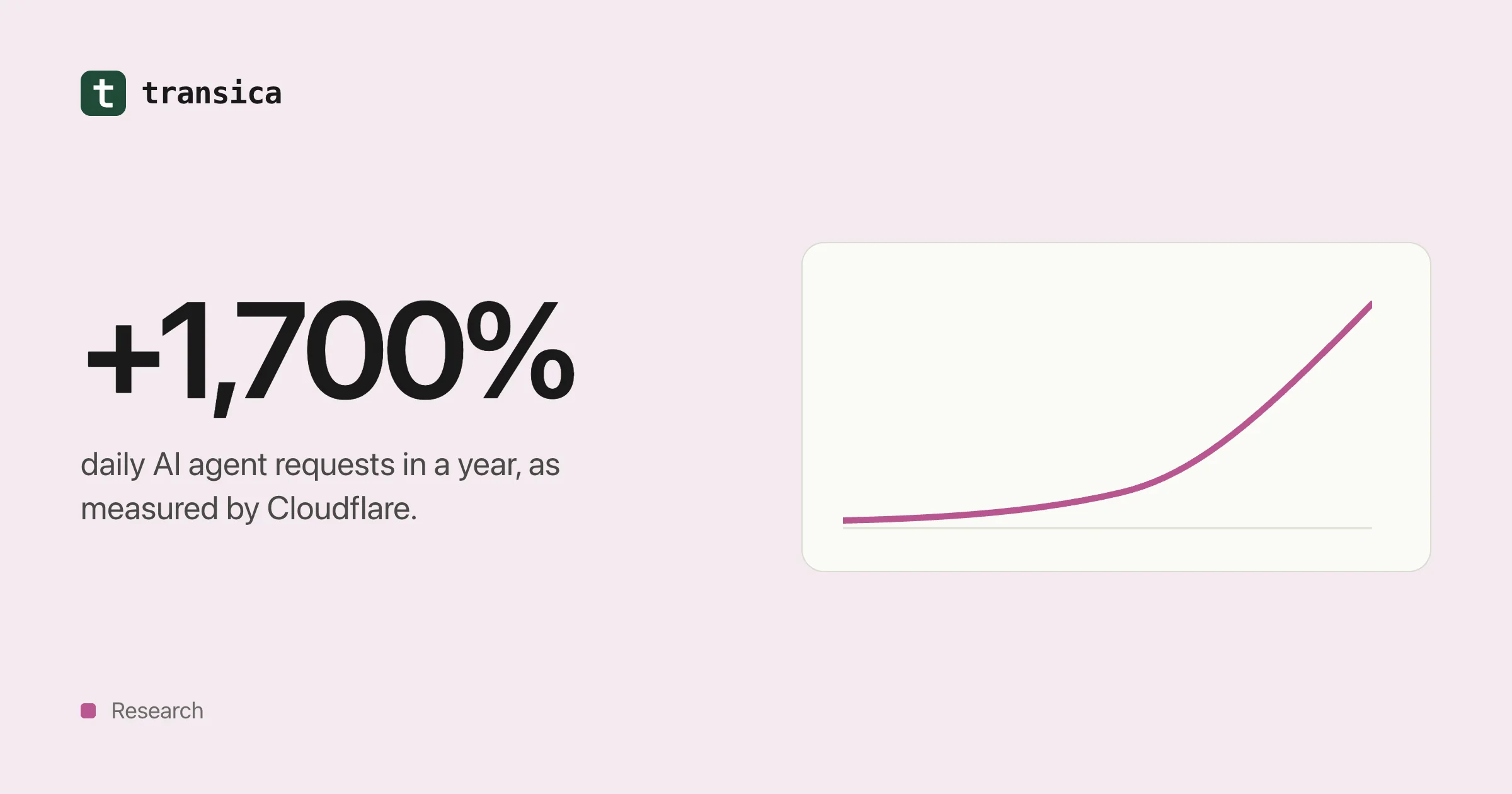
AI agent traffic in numbers (2025–2026)
What Cloudflare, Adobe, Pew, Imperva, HUMAN and Akamai have measured about AI crawlers and agents, what the numbers can and can't tell you, and what the shift means for your website.
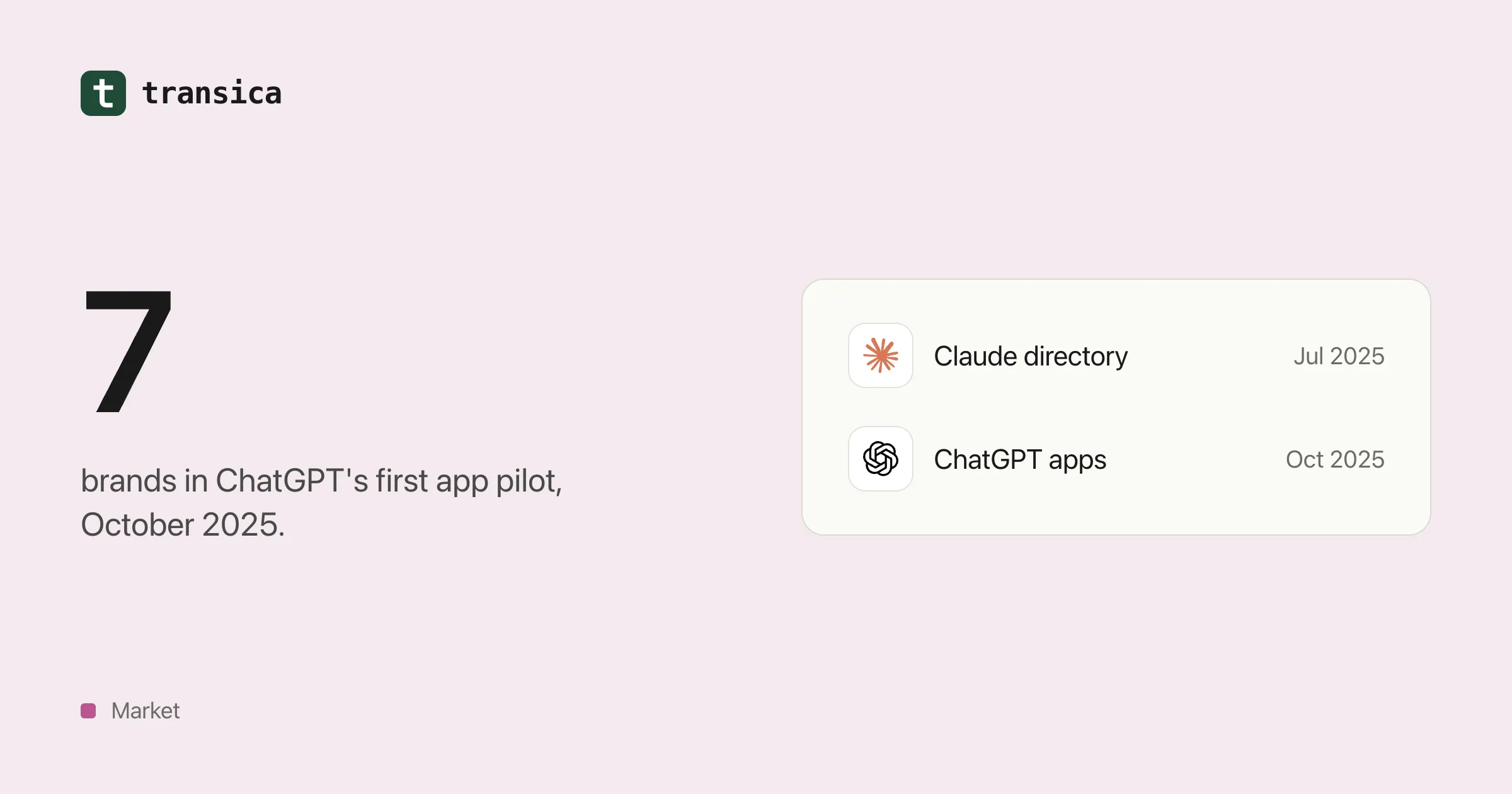
Who's already inside ChatGPT, Claude and Copilot
A dated timeline of the brands that built apps for AI assistants from 2024 to 2026, what those apps let people do, how the checkout experiment went, and what a mid-size business can take from it.