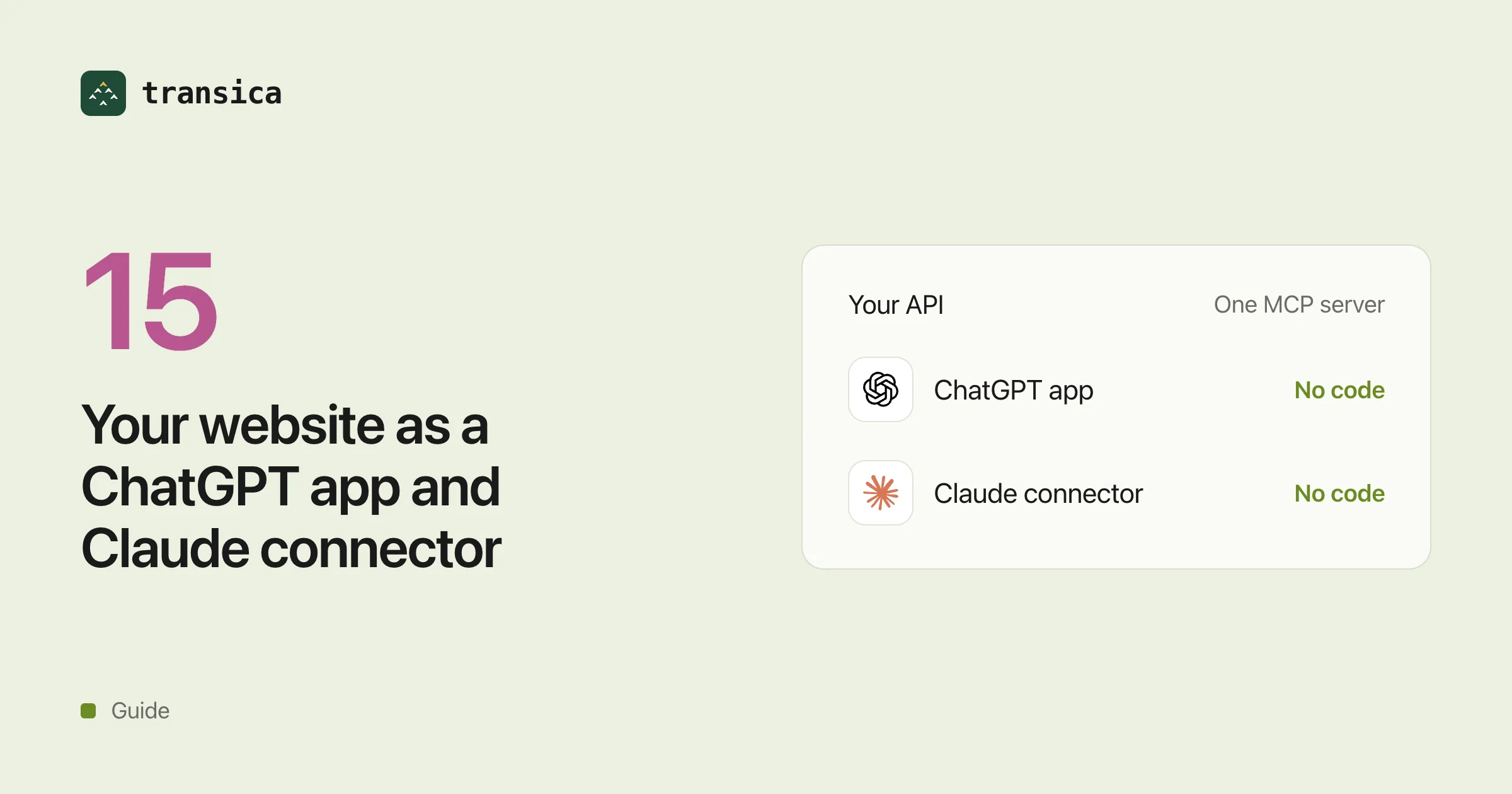
A website becomes a ChatGPT app and a Claude connector through one MCP server: a small service that turns the API behind your site into tools ChatGPT and Claude can call. Without writing code, a service builds that server from your API, hosts it, and signs your customers in with the login your site already has. The same server is then submitted to ChatGPT's plugin directory and Claude's Connectors Directory, where OpenAI and Anthropic review it. Customers find it there, sign in once and ask about their own account in the chat.
How do I turn my website into a ChatGPT app without building it myself?
- Find the API behind the site. A published OpenAPI spec is the fastest start.
- Choose the tools. Pick the questions customers ask most, such as order status, availability or account details, and approve one tool for each.
- Host the MCP server at a public HTTPS address, ideally on your own domain.
- Connect sign-in to your existing login for tools that read a customer's account.
- Test it in ChatGPT and Claude as a custom connector before anyone else sees it. See how to add your API as a connector.
- Submit it to each directory.
Can one MCP server work in both ChatGPT and Claude?
Yes. Both connect to remote MCP servers over HTTPS and both use OAuth with PKCE for signed-in tools (OpenAI, Anthropic). Each directory has its own review: ChatGPT wants exactly five passing and three failing test cases and a video, and Claude wants a title and a read-or-write annotation on every tool. One server can meet both.
What no-code tools make a connector from a website?
Read on each vendor's site on 4 November 2026:
| Tool | What it builds from | Hosting | Your own directory listing | Customers' sign-in | Price |
|---|---|---|---|---|---|
| Transica | Your API spec, or AI agents exploring your site | Included; own domain from Business | Checks, test prompts and the package; done-for-you on request | Your existing login | Free to build; Maker $19/mo |
| AnythingMCP | OpenAPI, Postman, SOAP, GraphQL, SQL | Its EU cloud or self-hosted | No | OAuth to the connected system; per-user sign-in on Enterprise | From €19/mo; self-hosted free up to 3 users |
| getmcp.com | OpenAPI, Swagger, Postman, cURL | You host it, as a PHP app or WordPress plugin | Not stated | Not stated | Free for 1 server; Pro $49/yr |
| Make | Your Make scenarios | Make | Not stated | Your Make account | Included in Make plans |
| Workato | Your Workato recipes and skills | Workato | Not stated | Agent actions use the signed-in user's identity | Quote only |
| Noodle Seed | Your website and documents, as an assistant | Noodle Seed's service | Growth plan includes submission to ChatGPT and Claude | Not stated | Free; Growth $99/mo |
Make and Workato expose automations to your own team's AI tools. AnythingMCP and getmcp.com turn an API into MCP tools for whoever connects them. For developer platforms, see Alpic alternatives.
Can it keep my site's login?
Yes, if the login can sign people in through OAuth. ChatGPT and Claude don't accept a shared API key for a public listing, so each customer signs in with their own account. If your identity provider, such as Auth0 or Clerk, lets the AI apps register themselves, it can serve them directly. If not, an authorization server in front of it sends customers to your usual login page. Provider by provider: MCP server authentication.
WarrantyWarden's ChatGPT plugin works this way: people sign in with their existing WarrantyWarden account, through its Supabase login, with no second account (case study).
Who submits it to the directories?
The business, from its own accounts: a verified OpenAI organization for ChatGPT and a paid Claude account for Claude. A service can prepare everything and run the submission with you, but OpenAI and Anthropic decide. Neither publishes a review time. WarrantyWarden was submitted by 13 October 2026 and approved on 29 October 2026. Checklists: ChatGPT and Claude.
How Transica does it
Transica builds the MCP server from your API: it finds the spec or sends AI agents through your site, drafts the tools, and you approve each one. It hosts the server on your domain, signs customers in with your existing login, checks every tool against both directories' rules, runs the review's test prompts and prepares both submissions. After listing, it checks the hosted app every 15 minutes and emails you when something breaks. The done-for-you listing, $1,500 one-time, adds the demo video and support through review.
Common questions
Can I make a ChatGPT app for my website without coding?
Yes. A no-code service builds the MCP server from your site's API and hosts it. You approve the tools and submit it to ChatGPT's plugin directory.
Is a ChatGPT app the same as a Claude connector?
They're the same MCP server. ChatGPT calls it an app or plugin, and Claude calls it a connector.
Does my website need an API?
Yes, tools call an API. Without a published spec, Transica's AI agents explore the site to find what to build.
Will ChatGPT recommend my app?
No one can promise that. A listing makes the app findable and installable; OpenAI and Anthropic decide how their directories rank listings.
How long does it take to get listed?
Building can take minutes; review takes as long as OpenAI and Anthropic need. WarrantyWarden's ChatGPT review ran from 13 to 29 October 2026.
Sources
All read on 4 November 2026.